
Skip to reading ↓

Lingerie · Chapter I of 9

Understanding Lingerie

Purpose, feeling and the vocabulary behind the pieces.

6 subjects · Read continuously, or jump to a subject.

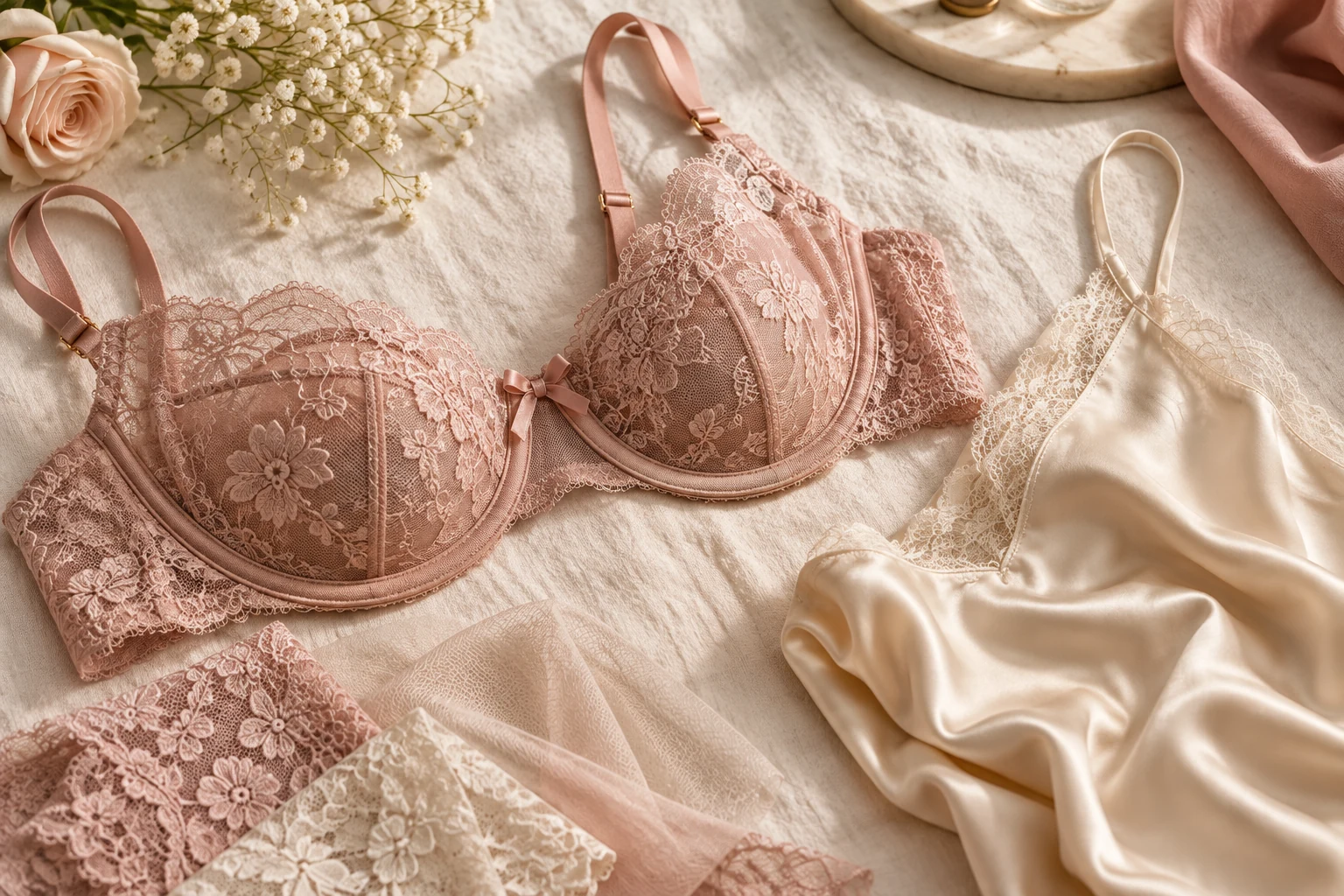
Illustrative still life of a blush lace bra, an ivory camisole and fabric swatches on cream linen.
Illustrative still life · Rose Chiffon

Before the names become useful, it helps to understand the ideas beneath them. Lingerie differs through shape, structure, coverage, fabric, purpose and feeling. The same basic garment can be practical or decorative depending on how those elements are combined.

This Chapter establishes the vocabulary used throughout the Book. Begin with what lingerie is, move through silhouette and mood, and learn to read a product description as a collection of distinct details.

Subject 1 · 2 min read

What Is Lingerie?

A family of garments, and more than one way to wear them.

can be practical, decorative, private, expressive, supportive, playful, quiet, or dramatic. Sometimes it is chosen because it needs to disappear beneath clothing. Sometimes it is meant to be seen. Sometimes its most important role is simply how it makes getting dressed feel.

This Book is not a catalogue of things to buy. It is a guide to understanding them.

The lingerie families

Different pieces. Different roles.

balconette construction studySimplified garment-only drawing. Actual cup height, wire shape and support vary. Labels identify components, not body measurements.

Bras

Cups, bands and ways of creating support.

mid rise with front rear coverageSchematic garment-only drawing. The waistband height and lower outline are independent.

Bottoms

Rise, leg cut and rear coverage.

fitted one-piece constructionGarment-only schematic, not a retailer product or a universal category definition.

One-pieces

A continuous design through the torso.

A starting map of the garment families covered in this edition, not a complete catalogue of lingerie.

A family, rather than a single style

Construction study

mid rise with front rear coverageSchematic garment-only drawing. The waistband height and lower outline are independent.
Look at the garment’s purpose and construction before letting a name make the decision.

The word lingerie covers a broad family of garments worn close to the body. Bras and briefs are part of that family, but so are bodysuits, teddies, corsets, chemises, slips, garter belts, , robes and babydolls. Some sit beneath clothing. Others are worn as private layers, or as part of an outfit in their own right.

A plain brief can be primarily functional. An embroidered brief cut from sheer mesh may perform the same basic task while also being designed around texture, colour, proportion and presentation. Neither is more legitimate. They simply place emphasis in different places.

Practical and beautiful are not opposites

An underwired bra may be beautifully embroidered. A bodysuit may function as intimate wear one evening and be layered beneath a blazer another. A slip can belong beneath a dress or be styled as a visible layer, depending on its construction and opacity.

The useful question is not whether a piece is sufficiently decorative to count as lingerie. It is what the garment is designed to do, and whether that purpose matches what you need.

How this Book approaches the subject

We look closely at the pieces themselves: how they are shaped, why they are constructed differently, and how familiar names relate to one another. You can read in sequence or open the contents and move directly to a question.

There is no requirement to own every kind of lingerie to understand it. Learning the language can make the pieces you already have more interesting, and make a future choice less confusing.

The right piece does not need to transform you. It should help you feel more at home in yourself.

Subject 2 · 2 min read

Lingerie and Underwear

An overlap of function, design and intention, not two opposing categories.

People often use lingerie and underwear interchangeably. There is considerable overlap, and there is no perfectly regulated boundary between them.

Underwear is the broader functional description: clothing worn beneath other clothing. Lingerie often brings design, fabric and presentation more explicitly into the conversation. That difference is a useful reading aid, not a rule about which garments deserve attention.

Start with the role

Construction study

mid rise with front rear coverageSchematic garment-only drawing. The waistband height and lower outline are independent.
Look at the garment’s purpose and construction before letting a name make the decision.

A bra can provide support, shape, coverage and decoration at the same time. A may be chosen for comfort beneath trousers, for its pattern, or for both. A can add coverage below a shirt and still be a lovely garment in its own right.

The distinction is therefore not practical versus beautiful. It is the balance of roles a piece has been designed to perform.

What design adds

Fabric changes the experience. Proportion changes the outline. Strap placement changes what clothing a bra can sit beneath. A lace edge, line of embroidery, open back or satin panel can add visual interest without removing the garment's practical purpose.

Likewise, a smooth, undecorated piece is not an absence of design. It may take careful construction to make a seam less noticeable or a waistband feel unobtrusive.

QuestionAn ordinary exampleA more decorative example
What is the garment?A briefA brief
What is its role?Everyday coverageCoverage and a particular visual mood
What may differ?Smooth knit and simple edgesLace, embroidery or contrasting panels
What still matters?Fit, comfort and careFit, comfort and care

Do not let the label choose for you

A retailer's lingerie category may include nightwear, while another separates it. A bodysuit might appear among tops on one site and intimate apparel on another. Those choices describe the retailer's organization as much as the garment.

Look at the actual construction, intended use and care information. You do not need to settle a vocabulary debate before deciding whether a piece belongs in your wardrobe.

Subject 3 · 2 min read

Begin With How You Want to Feel

Use mood as a starting point, then let practical details help you choose.

The first choice is not lace, , black or blush. It is the mood the piece is meant to support.

You may want softness. You may want structure. You may want something quiet enough to disappear beneath a favourite dress, or a detail that changes the mood of getting dressed before anyone else sees it.

Name the feeling

Construction study

The Rose Books

Lingerie

Pieces, shapes, fabrics
and an intimate wardrobe

Lingerie book cover: a bra, brief and botanical linework
An illustrated reference
Look at the garment’s purpose and construction before letting a name make the decision.

Romance, simplicity, ease, familiarity and drama can all be useful starting points. Naming the feeling narrows the conversation without forcing you into a particular product category.

You might discover that the feeling you called romantic comes from soft drape rather than lace. What you called confident may be the relief of not having to adjust a garment throughout the day. What you called a statement may be a colour rather than a more revealing cut.

Translate mood into observable details

Once you know the feeling, look for the design choices that might support it. A soft behaves differently from a structured cup. A babydoll moves differently from a fitted teddy. A coordinated bra and brief set creates a different visual rhythm from one continuous bodysuit.

Choose one or two details to investigate: texture, cup shape, drape, opacity, colour, coverage or a particular neckline. This is more useful than asking a single piece to represent an entire new identity.

Let practicality participate

Mood does not override comfort, dressing requirements or care. A piece that looks quiet may have prominent seams beneath a thin top. A dramatic one-piece may need more torso adjustment than a simple set. A silk layer may ask for a care routine you do not enjoy.

These are not reasons to avoid the piece automatically. They are reasons to understand it before deciding.

Keep the choice personal

The right piece does not need to transform you. It should support the experience you want to have. That might be an ordinary morning rather than a special occasion.

A private preference is enough. There does not need to be an audience for the choice to matter.

Subject 4 · 2 min read

Silhouette and Shape

Understanding the outline before deciding whether it belongs in your wardrobe.

is the bridge between visual interest and real-life wear. It describes the outline a garment creates and the way that outline changes as fabric follows, holds or moves around the body.

A useful silhouette description explains the piece without ranking bodies. It tells you what the garment is doing, not what you ought to look like.

The lingerie families

Different pieces. Different roles.

balconette construction studySimplified garment-only drawing. Actual cup height, wire shape and support vary. Labels identify components, not body measurements.

Bras

Cups, bands and ways of creating support.

mid rise with front rear coverageSchematic garment-only drawing. The waistband height and lower outline are independent.

Bottoms

Rise, leg cut and rear coverage.

fitted one-piece constructionGarment-only schematic, not a retailer product or a universal category definition.

One-pieces

A continuous design through the torso.

A starting map of the garment families covered in this edition, not a complete catalogue of lingerie.

Follow, float or structure

Construction study

mid rise with front rear coverageSchematic garment-only drawing. The waistband height and lower outline are independent.
Look at the garment’s purpose and construction before letting a name make the decision.

A fitted generally follows the torso more closely. A often introduces a looser section beneath the bust. A chemise can create a more continuous, dress-like line. Corsetry introduces deliberate structure through panels, reinforcement and fastenings.

These are tendencies, not identical patterns repeated by every manufacturer. A draped teddy and a fitted chemise can complicate the simple categories. That is why this Book pairs definitions with closer observations.

Separate outline from support

A garment may look structured without providing much bust support. A sheer cup may look light while using carefully shaped seams and firm materials. A high-waisted brief may be decorative rather than shaping.

Silhouette tells you about the outline. Construction tells you how the garment holds that outline. Read both before making assumptions about the way it will feel.

Look at more than the front photograph

The side and back can reveal details hidden from a front view: how far a band extends, how a bodysuit fastens, whether a brief has reduced rear coverage, or where straps connect.

Movement adds another question. Where the retailer's try-on conditions allow it, notice how the garment behaves while sitting and moving, not only while standing still. Keep hygiene protection and labels intact as required.

Use shape to make comparisons

Rather than searching for a universally flattering category, make a specific comparison. Would you prefer a looser lower section, a lower centre neckline, a higher waistband or less visible texture?

Those observations lead naturally to the detailed garment Pages. They also leave room for your preferences to change over time.

Subject 5 · 2 min read

Colour, Occasion, and the Moment

A personal palette and a practical setting can make the next choice clearer.

Colour can give a familiar piece a different role before construction is even considered. Black might feel quiet one day and dramatic another. Ivory may suggest a bridal mood to one reader and an everyday neutral to another.

These associations are personal and cultural, not fixed properties of the colour. Use them as invitations rather than instructions.

Build a colour story

Construction study

The Rose Books

Lingerie

Pieces, shapes, fabrics
and an intimate wardrobe

Lingerie book cover: a bra, brief and botanical linework
An illustrated reference
Look at the garment’s purpose and construction before letting a name make the decision.

A small palette can make coordination easier. Perhaps you enjoy black, ivory and blush. Perhaps you prefer deep red and jewel tones, or soft neutrals with one vivid accent.

There is no obligation to own every colour. A repeat shade can help different pieces feel connected, while contrast can make a familiar silhouette feel new. Texture changes the result too: matte cotton and glossy satin need not read the same way even in a similar shade.

Think about the clothing above it

When lingerie needs to disappear, consider the actual outer fabric in the light in which it will be worn. Colour contrast, seams, edges and transparency all participate in the result. A colour called nude is not one universal skin match.

When lingerie is intended as a visible layer, coordination becomes a different question. You can choose continuity with the outfit or deliberate contrast. Neither is automatically more elegant.

Let the occasion clarify the job

The priorities beneath a fitted dress may be smoothness, support and an unobtrusive closure. A getting-ready may be chosen for ease. A private evening might invite a stronger visual statement. Travel can make packing space and care more important.

You do not need a separate wardrobe for every occasion. The same garment may have several useful roles, provided its construction supports them.

Choose beyond the photograph

A product photograph can suggest an atmosphere, but your own clothing and routine determine the practical requirements. Notice the detail you enjoy, then ask whether it belongs in the situation you actually have in mind.

That is how colour and occasion turn browsing into a more deliberate choice without turning the wardrobe into another set of rules.

Subject 6 · 2 min read

The Language of Coverage, Structure, and Detail

A small vocabulary that makes product descriptions much more informative.

Lingerie descriptions often return to the same ideas. Understanding them makes it easier to separate what a garment is called from what it actually contains.

These terms describe different characteristics. They are not competing categories, and several can apply to the same piece.

Coverage and rise

Construction study

mid rise with front rear coverageSchematic garment-only drawing. The waistband height and lower outline are independent.
Look at the garment’s purpose and construction before letting a name make the decision.

Coverage describes how much of an area the garment encloses. In bras, it often refers to how high and far the cups extend. In bottoms, front and should be considered separately.

describes where a bottom's waistband reaches on the wearer. A high rise does not guarantee a full back. A higher leg opening is another independent detail. The Briefs & Bottoms Chapter makes these distinctions visible.

Support and structure

Support describes how a garment manages weight, position and movement. Structure refers to the means used to create or hold its form: , seams, boning, reinforced fabric, lining, firm bands and other components.

A wireless bra can still have substantial structure. A corset-inspired fashion piece may have less shaping capacity than its appearance suggests. Read the construction rather than assuming one visible feature tells the whole story.

Projection and cup shape

Projection describes forward depth. A cup can be relatively shallow or more projected, independently of the size printed on its label.

That helps explain why two bras carrying the same size can behave differently. This Book introduces the garment; detailed breast-shape and fitting guidance belongs in the Fit Book as it develops.

Lining, padding and sheerness

Lining adds a layer for purposes such as opacity, reinforcement or comfort. Padding adds material that may change contour or reposition volume. Neither term is a synonym for moulded, which describes how a cup is formed.

Sheer and opaque describe visibility through the textile. An unlined garment need not be sheer, and a sheer garment need not be unsupported.

Seaming, stretch and finish

Seams join panels and can help create three-dimensional form. Stretch allows material to extend; recovery describes its tendency to return. Edge finishing, elastic, rings, sliders and fastenings affect the parts that touch the body.

With those distinctions in mind, the names in the next Chapter become easier to understand. Bras are not a collection of unrelated inventions. They rearrange a familiar set of components in different ways.

Carry the idea forward.

You do not need to own every style to understand it. With the language established, the next Chapter examines the components and shapes of bras.

Continue through Lingerie

Within The Rose Books

Find your subject.

Results jump to the subject within its Chapter, in a new tab.

    A word from the Book

    Definition